Categories
Festival Ordinary Time

Reflection on Matthew 20.20-28 (James, 25.07.2020)

We live in a world where people crave power, as though it should be the ultimate goal in everyone’s life.

Newly elected politicians enter parliament with their eye on the top job, no matter how strident their message of service to others might be. That is just how the system works.

Newly appointed employees enter a company with their eye on the boss’s office. Being seen as ambitious is often the very quality that earns the aspiring applicant the job. That is just how the system works.

In the church, many seek to be the person everyone turns to for advice, and decisive action. Those people revel in their influence and power. They come to see themselves as being indispensable. That is how the system works.

We are presented with a role model for this attitude in today’s reading, if we choose to misread scripture in that way –

  • James, the brother of John, who, with John and Peter, constituted the innermost circle of Jesus’ companions;
  • James, the one who was an eye witness to Jesus’ life, work, death, and resurrection;
  • James, who had seen the raising of Jairus’s daughter, the moment of transfiguration and the agony in the garden;

James, along with his brother and his mother, comes to Jesus, to ask for a position of power. That may be how he saw it all working, but Jesus’ response makes it clear that he could not have got it more wrong.

Our place in the pecking order is set by God. It is for us to set aside our ambition, and to trust in God.

The system we live in does not understand this. But that is the Christian calling.

  • For some, this will mean living a life of humble servitude to the needs of others.
  • For others, this will mean being promoted way beyond where we feel our competence and expertise lies.
  • From all, it demands a faith that is humble and accepting of God’s generous grace and love.

As Jesus challenges the motivation that lies behind the request of James and John and their mother, he asks them just how far they are prepared to go in his name. Are they prepared even to drink from the same cup that he will have to drink from?

At this point, they still do not fully understand the purpose of Jesus’ journey towards Jerusalem, and, therefore, cannot really understand the meaning of the cup of self sacrifice, from which Jesus is destined to drink.

But they do commit themselves to the total journey of lifelong faith.

Therein lies the message for us all, today.

  • Are we ready to share in the cup from which Jesus had to drink?
  • Are we ready to set aside our need for power, in order that we might follow the path he has laid for us?
  • Are we ready, in fact, to take the lowest place, rather than dash for the highest, in order that we might draw ever closer to our Lord and Saviour, Jesus Christ?
Categories
Ordinary Time

Reflection on Matthew 13.18-23 (Week 16 Friday, 24.07.2020)

Yesterday, I reflected upon Jesus’ explanation of why he taught in parables rather than indirect speech. Today we go straight into Jesus’ own explanation of the parable of the sower.

Jesus’ parables are like puzzles. They challenge us to take his word painting and work out the answer. He wants us to find. Each parable has one correct answer, and many blind alleys and irrelevant pathways which either delay and divert us, or prevent us from ever arriving at the truth.

The parable of the sower is a powerful challenge in its own right. It challenges us to examine where and how we are planted in a world full of rocks and thorns and worse. Then it challenges us, to turn the environment we inhabit into the good soil, where we will see the word of God flourish and thrive.

We are challenged, in fact, to be the seed of the good soil, that will allow self to die, in order that the word of God, that is Jesus Christ himself, might grow into the strongest, the tallest, the most powerful of plants in this world.

We all see people who are so caught up in their own worlds of self-interest that the word of God will probably never penetrate the path they have laid all around themselves.

We have all met people whose enthusiasm for the Christian message seems to be a shining example for others – that is, until something difficult comes into their lives.

We have all encountered people, who have become so overwhelmed with the difficulties of daily life, that their Christian lives have been either put on hold or abandoned completely.

And, mercifully, we have all seen those, comparatively few, who are totally rooted in their faith, no matter what may happen to them.

Jesus’ solution to the puzzle of the parable of the sower is not one of agricultural economics. His solution is one of faith, and nothing else. His solution challenges us to become one of the totally rooted Christians, whose example leads others into his nearer presence, through our acts of love and service.

I hope and pray that we may all join that blessed company of faithful souls, who, through our words and our deeds, bring many, many others, into a true relationship with Jesus Christ, the one who died and rose again for us all.

Categories
Ordinary Time

Reflection on Matthew 13.10-17 (Week 16 Thursday, 23.07.2020)

I have always enjoyed visiting old churches and cathedrals. I enjoy standing in the places where for centuries, faithful souls have prayed to and worshipped God. I enjoy looking at the different architectural styles that have been brought together to create one glorious whole. I like to find the evidence of how individuals down the ages have lived out their lives of faith.

One of the thoughts that goes through my mind every time I visit one of those grand old buildings is about the many, many people who have been involved in the development of those buildings. What motivated them to work on massive building projects, when two thirds of the population was being wiped out by the Black Death? What inspired them to find ingenious ways to fly in the face of political and religious pressure to change their styles of worship? What held them together when local disputes bubbled over into schism and violence?

All of these thoughts tie into our reading for today.

The Jewish people had long looked for the coming of their Messiah, the anointed one of God, who would restore their former glory and primacy in the world. They had endured many hardships through hundreds and hundreds of years, and yet they had remained faithful to the promise that the Messiah would one day come amongst them and save them. Through the passage of time many people made their small contributions to the story of his Israel, never expecting to see the true worth of what they had said or done.

As with the people of Israel, so with those faithful souls, who each made their small contribution to each Christian community that we call a parish.

Jesus understood the workings of the human mind. Jesus understood that we struggle to grasp the true picture, because it is painted on far too large a canvas for us to take it all in at once, in revealing the great truths of God.

Jesus spoke in parables, in stories that engage with our normal everyday lives, in doing so. He was not doing anything particularly new.

In today’s reading, he quotes from the prophet Isaiah, who wrote of the One who would come and teach a new lesson, which would be difficult for many to understand.

And that is where we stand in the sweep of the Christian story. We become so obsessed with our version of the Christian message that we stop listening, hearing, seeing, and understanding.

Recently, I wrote in my weekly letter to parishioners of the parable of the sower. In response to that letter, I received 11 emails, an unprecedented number, which focussed on explaining how agricultural economics works in the 21st century. Not one of those emails gave me the same explanation, and not one of them mentioned the true message of the parable.

Let us set aside our human wisdom, and let us listen, hear, see, and understand the true message of Jesus Christ, the Messiah, the anointed one of God, our Lord and our Saviour.

Categories
Festival Ordinary Time

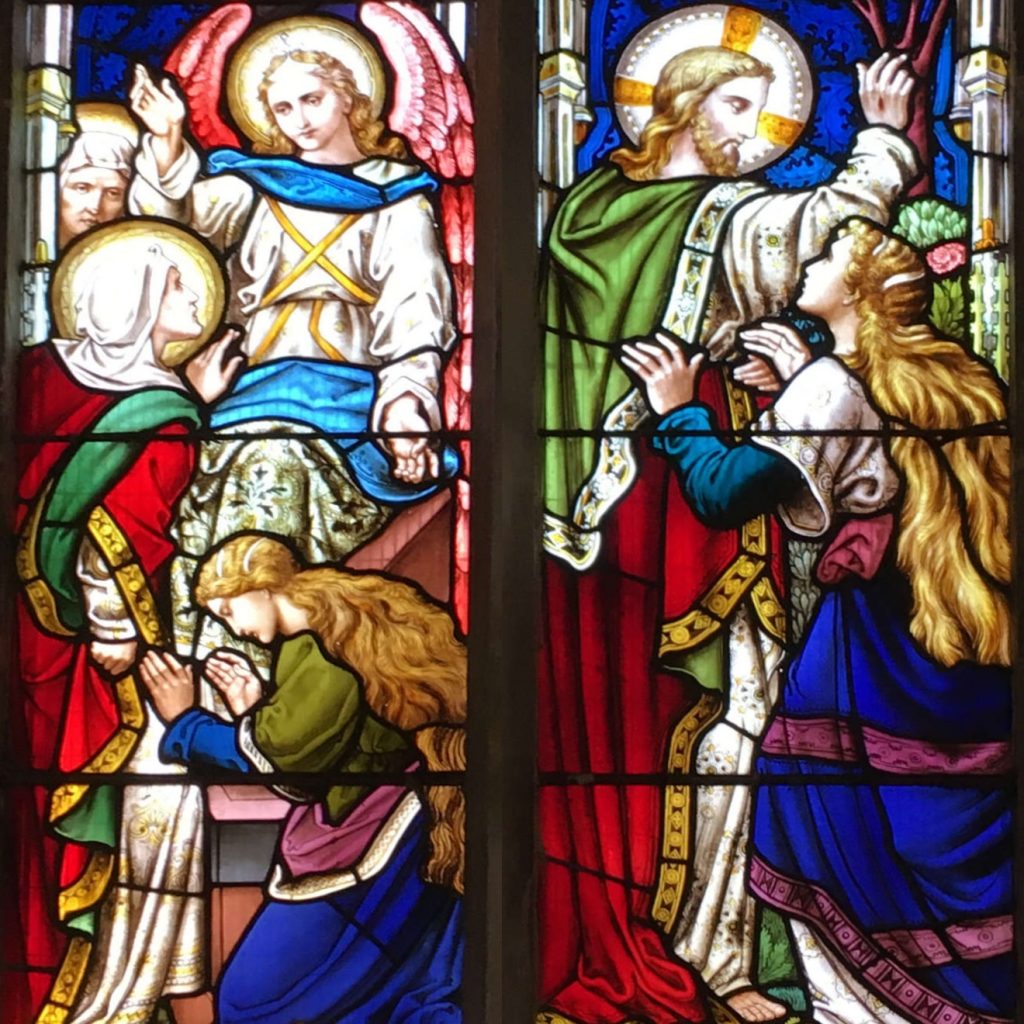
Reflection on John 20.1-2, 11-18 (Mary Magdalene, 22.07.2020)

The two outer panels of the south window in the Sanctuary of Corby Glen Church depict Mary Magdalene on the first Easter day

Today, the church remembers Mary Magdalene in the gospels of Matthew, Mark and Luke. Mary Magdalene is described as one of the women from Galilee, who gave financial and domestic support to Jesus and his disciples. She is also described as having been present at Jesus’ crucifixion and burial. However, it is in John’s gospel that Mary Magdalene is given pride of place as the first witness of the resurrection and of the risen Christ himself.

Down the centuries, a considerable mythology has grown up around the persona of Mary Magdalene, much of it negative. In fact, the gospels give little evidence of her character. It is only in Luke’s gospel that we read seven demons had gone out of her, and it is generally assumed that it was Jesus who had exorcised her. This reference is followed immediately by the account of Jesus’ feet being anointed by a sinful woman at the house of Simon the Pharisee. Rightly or wrongly, it has been assumed by many, that the sinful woman was Mary Magdalene.

So why does the church remember this little-known character from the gospel narrative? The answer, I believe, lies in today’s reading.

It was Mary Magdalene, not one of the twelve, who found the empty tomb, and first encountered the risen Christ.

It was also to Mary Magdalene that something new was revealed. In the midst of the tears and the joy that must have overwhelmed Mary, Jesus gave her news of a new relationship between God himself and the whole of humanity.

Jesus said, Go to my brothers. Previously, they had been his disciples, servants, or friends.

Jesus said, I am ascending to my Father, and your Father; my God, and your God. Previously Jesus had spoken of the Father, or the Father who sent me, or my Father.

To this faithful penitent, the risen Christ revealed, in just a few words, tucked into the shadow of the most amazing moment in human history, an invitation to us all, an invitation to become his brother or sister, a child of the same heavenly Father, the Father who is also the one true God.

I hope and pray that you are rushing to accept that invitation right now.

Categories
Ordinary Time

Reflection on Matthew 12.46-50 (Week 16 Tuesday, 21.07.2020)

I am sure that we have all heard the proverb The road to hell is paved with good intentions.

Perhaps fewer of us have come across its alternative form: Hell is full of good meanings, but heaven is full of good works.

It is so easy for all of us to intend to do good. But so often those intentions slip further and further down our to-do lists. We become distracted and diverted, and we quickly forget all that good we intended to do.

Very often the distractions and diversions that get in the way of our Christian discipleship are rooted in family and friends. Some sort of personal crisis, whether real or perceived, arises, and every good work we intended to do is swept aside.

It is in exactly these sort of circumstances that the terrible phrase charity begins at home is used. We forget Christ’s teaching on love and service. We cast aside the challenge to love our neighbour as ourselves. We do not give a second thought to Jesus’ teaching that every time we care for a stranger, we are caring for him.

And to make the situation worse, our families and friends often demand that they be given priority over everything else, no matter how trivial their need, simply because they are family and friends.

In today’s reading, Jesus seems to have very harsh words to say about his family. But does he really?

Jesus is addressing the crowds. He is teaching those who have come to hear the good news. Unexpectedly, his family show up, and we are told they want to speak to him.

Now read the text carefully.
Jesus does not dismiss them or reject them.
Nowhere does it say that he does not go out and speak with them.
Instead, the text says that he uses their presence as an illustration.

Jesus says to his disciples, as he says to us, You too can be part of my family if only you will set aside the transient good intentions, and live the life of faithful discipleship.

So, how are our to do lists looking? Are Christian love and service at the top of the list? Are we strong enough to keep Christian love and service as our number-one priority?

Categories
Ordinary Time

Reflection on Matthew 12.38-42 (Week 16 Monday, 20.07.2020)

I really enjoy doing crosswords when I pick up a newspaper. I always take a quick look at the crossword first – I like to see what sort of intellectual challenge lies ahead of me. Has this one been set by someone who thinks like me, or is it going to be a linguistic fight to the death? Am I going to know the satisfaction of completing the grid, or am I going to be wishing I could ask the setter for a different more accessible clue?

In today’s reading, we encounter the scribes and the Pharisees asking Jesus for a more accessible and comprehensible clue.

We also encounter Jesus saying, in effect, ‘No, work it out for yourselves.’

Of course, those scribes and Pharisees are surrounded by clues. They really do not need any more. The Hebrew scriptures, which we know as the Old Testament, is overflowing with relevant prophecies.

Jesus himself is present with them. Through his teaching and signs of power, he is bringing the Old Testament prophecies to life.

But, despite all of those clues, the scribes and the Pharisees just cannot see the answer they are looking for. The day is coming when it will be impossible to miss the answer. When Jesus has died and then risen from the grave, everyone will know the truth. But until then, human doubt, uncertainty, and scepticism keeps the scribes and the Pharisees from completing the puzzle.

Jesus does try to help them. He points them towards two easily understood stories from their own scriptures, but still the connections are not made.

So how are we doing with the puzzle? Are we so caught up in following our own agenda that we are missing the blindingly obvious? Or, can we at last see who Jesus is, and what he came to earth to do?

And if we are able to complete the puzzle, have we also found the strength and the determination to live the life of love and service that was modelled by Jesus himself?