Categories
Festival Holy Week Lent

Palm Sunday 2020

The service for Palm Sunday comprises three parts:

  • The Commemoration of the Lord’s Entry into Jerusalem
  • The Liturgy of the Word, including the Passion Reading from the gospel according to Matthew
  • The Liturgy of the Sacrament

The service uses the liturgy published in Common Worship, with suggestions for how isolated individuals might join with the company of the wider virtual church in celebrating the festival.

Commemoration of the Lord’s Entry into Jerusalem (Palm Sunday 2020). Reading: Matthew 21.1-11

The Liturgy of the Word (Palm Sunday 2020). Readings: Isaiah 50.4-9a; Philippians 2.5-11; Matthew 26.14 – end of 27

The Liturgy of the Sacrament (Palm Sunday 2020)

Categories
Festival Ordinary Time

Reflection on Matthew 20.20-28 (James, 25.07.2020)

We live in a world where people crave power, as though it should be the ultimate goal in everyone’s life.

Newly elected politicians enter parliament with their eye on the top job, no matter how strident their message of service to others might be. That is just how the system works.

Newly appointed employees enter a company with their eye on the boss’s office. Being seen as ambitious is often the very quality that earns the aspiring applicant the job. That is just how the system works.

In the church, many seek to be the person everyone turns to for advice, and decisive action. Those people revel in their influence and power. They come to see themselves as being indispensable. That is how the system works.

We are presented with a role model for this attitude in today’s reading, if we choose to misread scripture in that way –

  • James, the brother of John, who, with John and Peter, constituted the innermost circle of Jesus’ companions;
  • James, the one who was an eye witness to Jesus’ life, work, death, and resurrection;
  • James, who had seen the raising of Jairus’s daughter, the moment of transfiguration and the agony in the garden;

James, along with his brother and his mother, comes to Jesus, to ask for a position of power. That may be how he saw it all working, but Jesus’ response makes it clear that he could not have got it more wrong.

Our place in the pecking order is set by God. It is for us to set aside our ambition, and to trust in God.

The system we live in does not understand this. But that is the Christian calling.

  • For some, this will mean living a life of humble servitude to the needs of others.
  • For others, this will mean being promoted way beyond where we feel our competence and expertise lies.
  • From all, it demands a faith that is humble and accepting of God’s generous grace and love.

As Jesus challenges the motivation that lies behind the request of James and John and their mother, he asks them just how far they are prepared to go in his name. Are they prepared even to drink from the same cup that he will have to drink from?

At this point, they still do not fully understand the purpose of Jesus’ journey towards Jerusalem, and, therefore, cannot really understand the meaning of the cup of self sacrifice, from which Jesus is destined to drink.

But they do commit themselves to the total journey of lifelong faith.

Therein lies the message for us all, today.

  • Are we ready to share in the cup from which Jesus had to drink?
  • Are we ready to set aside our need for power, in order that we might follow the path he has laid for us?
  • Are we ready, in fact, to take the lowest place, rather than dash for the highest, in order that we might draw ever closer to our Lord and Saviour, Jesus Christ?
Categories
Festival Ordinary Time

Reflection on John 20.1-2, 11-18 (Mary Magdalene, 22.07.2020)

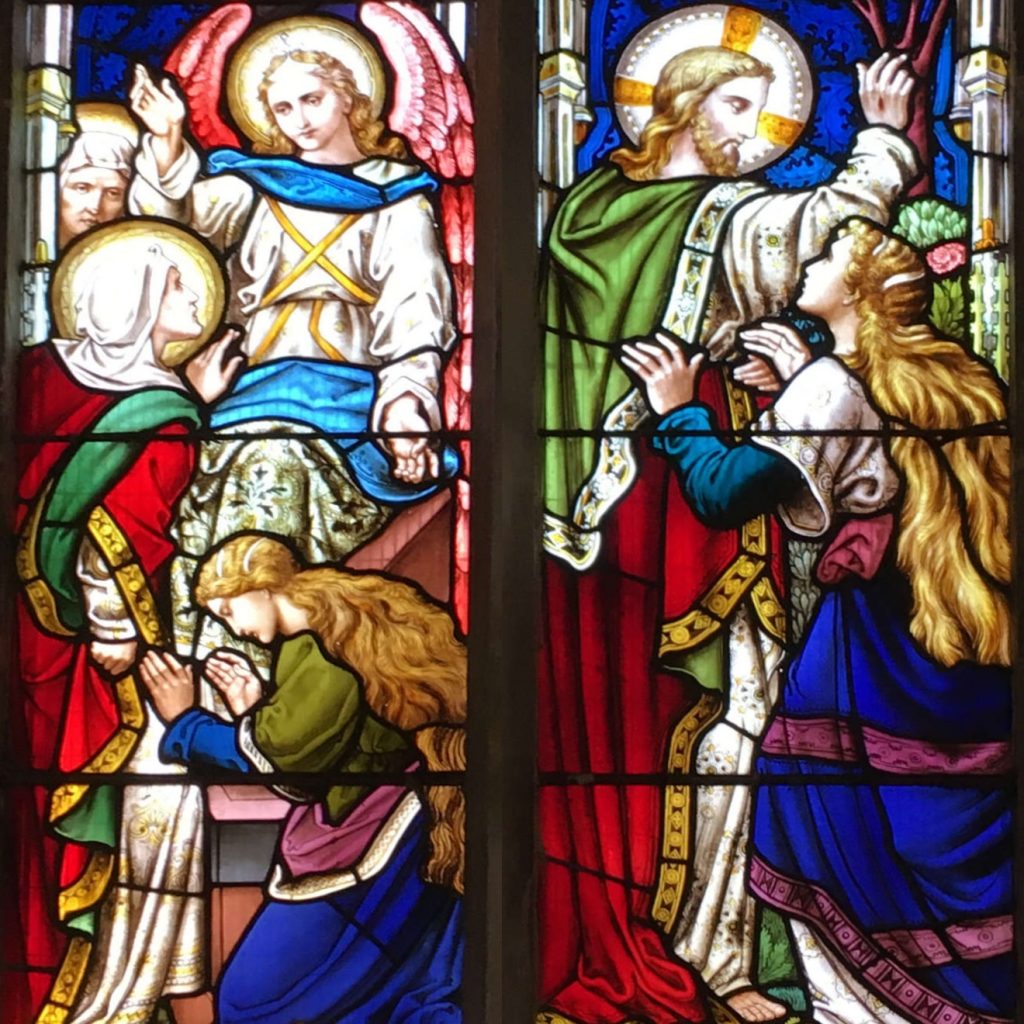
The two outer panels of the south window in the Sanctuary of Corby Glen Church depict Mary Magdalene on the first Easter day

Today, the church remembers Mary Magdalene in the gospels of Matthew, Mark and Luke. Mary Magdalene is described as one of the women from Galilee, who gave financial and domestic support to Jesus and his disciples. She is also described as having been present at Jesus’ crucifixion and burial. However, it is in John’s gospel that Mary Magdalene is given pride of place as the first witness of the resurrection and of the risen Christ himself.

Down the centuries, a considerable mythology has grown up around the persona of Mary Magdalene, much of it negative. In fact, the gospels give little evidence of her character. It is only in Luke’s gospel that we read seven demons had gone out of her, and it is generally assumed that it was Jesus who had exorcised her. This reference is followed immediately by the account of Jesus’ feet being anointed by a sinful woman at the house of Simon the Pharisee. Rightly or wrongly, it has been assumed by many, that the sinful woman was Mary Magdalene.

So why does the church remember this little-known character from the gospel narrative? The answer, I believe, lies in today’s reading.

It was Mary Magdalene, not one of the twelve, who found the empty tomb, and first encountered the risen Christ.

It was also to Mary Magdalene that something new was revealed. In the midst of the tears and the joy that must have overwhelmed Mary, Jesus gave her news of a new relationship between God himself and the whole of humanity.

Jesus said, Go to my brothers. Previously, they had been his disciples, servants, or friends.

Jesus said, I am ascending to my Father, and your Father; my God, and your God. Previously Jesus had spoken of the Father, or the Father who sent me, or my Father.

To this faithful penitent, the risen Christ revealed, in just a few words, tucked into the shadow of the most amazing moment in human history, an invitation to us all, an invitation to become his brother or sister, a child of the same heavenly Father, the Father who is also the one true God.

I hope and pray that you are rushing to accept that invitation right now.

Categories
Festival Ordinary Time

Reflection on John 20.24-29 (Thomas, 03.07.2020)

There are very few Christians who can say that they have never experienced times of doubt.  Even our Archbishop of Canterbury Justin Welby once spoke to a journalist of his own times of doubt.

In the verses immediately preceding today’s reading we hear of the other disciples rejoicing, only after Jesus had shown them his hands and his side.

We should not be surprised by Thomas’ doubt. In fact, we could view it as an example of faithful discipleship. Jesus had warned his followers to be wary of false messiahs and false prophets. Thomas was being cautious and taking care to obey his Lord and Master.

Despite these additional thoughts, we still identify Thomas as being the one who doubted.

Faith is an essential part of living as a Christian. None of us can share in the first disciples’ privileged position of actually seeing the risen Jesus, complete with the wounds of the crucifixion. We have to number ourselves with those who have not seen and yet have come to believe.

For many, belief comes before faith. These people develop a confidence in their picture of Jesus, and then comes the personal commitment to follow him in faith. For others, the process is reversed, a leap of faith is made without a foundation of any particular beliefs. Wherever we are on this spectrum, belief and faith each give rise to doubt.

For many Christians doubt occurs whenever a gap opens between our personal experience and the picture of dogma, tradition and scripture that we have chosen to live by.

It is commonly thought that strong faith never doubts. But … we need to be wary of that phrase ‘strong faith’. What it usually means is ‘faith set in concrete’: beliefs and religious practices that are never allowed to vary and develop, beliefs and religious practices that eventually stand in the way of us developing a living relationship with our Living God.

Thomas doubted. But, Thomas was ready to have it proved that he was wrong. His strong faith in Jesus still allowed his mind to open when confronted with something new, something unexpected, something that had definitely never been seen before.

Then Thomas spoke those words that should be ever on our own lips: My Lord and my God.

May those words of Thomas be ever with us as we face the challenges that cause us to share in his moments of doubt.

Categories
Festival Ordinary Time

Reflection on Matthew 16.13-19 (Peter and Paul, 29.06.2020)

But who do you say that I am?

That is a question that is very much associated with the Festival of Peter and Paul, because this is the festival in the Church’s calendar that is most associated with the ordination of deacons and priests.

All of those who have accepted God’s call in their life, and have made the long arduous journey to ordination, must have an answer to this question, and that answer needs to be the same as Peter’s.

Jesus asked the apostle whom he would rename ‘Peter’ (meaning rock) to set aside the view of the crowds, and make his own declaration of faith.

Those to be ordained deacon or priest stand before their Bishop, their family and friends, and the whole of the Church of Christ and make a lot of declarations and promises.

Those declarations and promises sound like an employment contract turned into a litany, but … in fact … they are asking each candidate for ordination the question that Jesus asked of Simon Peter – who do you say that I am?

Of course, Jesus does not only ask that question of those who are about to enter the formal ministerial life … he also asks that question of us.

So many times I have witnessed people being asked about their churchgoing or their Christian beliefs, and so many times I have heard replies designed to ‘cloud the issue’, to soften the straightforward truth, to avoid professing a commitment to Jesus Christ.

Have you ever done that?

Today, Jesus is giving us the opportunity to think again.

Today, he is reminding us of that momentous question … but who do you say that I am?

Today, we are being given the chance to set aside doubt and uncertainty, embarrassment and shyness, and shout from the rooftops: ‘You are the Messiah, the Son of the living God.’

That moment of commitment led simple, humble Peter down a very different path in life; you never know, perhaps God has got big plans for you too.

Or … perhaps God just wants you to shine out as his light in this community, sharing his love with all you meet.

Whichever way it plays out, the decision is God’s alone; we just have to be ready for the moment when he asks us that question: But … who do you say that I am?
Categories
Festival Ordinary Time

Reflection on Luke 1.57-66, 80 (Birth of John the Baptist, 24.06.2020)

Today’s reading is about the birth and naming of John, but it is also about the breaking of Zechariah’s great silence.

Nine months earlier Zechariah had been visited by the angel Gabriel. During that visitation Gabriel told Zechariah that his elderly wife would bear a son who would become a great prophet. 

Zechariah was a simple priest who lived a devout life with his wife, Elizabeth. They were not ready for all this talk of angels and prophets. Zechariah expressed his doubt and his power of speech was taken away. Zechariah entered nine months of silence and isolation.

Today’s reading describes the moment when Zechariah, inspired and empowered by God, broke his silence: the moment when his private contemplations came to an end; the moment when he broke with tradition and declared the unexpected; the moment when he unreservedly let God take the lead in his life.

Too often, when we encounter this reading we focus on the prophetic role that John will take up. But, during these strange times, it is also worth pausing and considering Zechariah. That devout and faithful man was suddenly plunged into a situation of confusing and apparently inexplicable isolation. He emerged from that time stronger because of his faithful prayer and obedience to God’s will.

When the time comes, will we find our relationship with God to have become as strong as that of Zechariah, or will we have allowed our prophetic voices to remain silenced through doubt and uncertainty?

The decision to be bold and follow God is ours to make!