Categories
Holy Week Lent

Daily Prayer for Holy Week 2020

Daily Prayer for Monday of Holy Week, 6 April 2020

Daily Prayer for Monday of Holy Week 2020. Readings: Psalm 36.5-11; John 12.1-11

Daily Prayer for Tuesday of Holy Week, 7 April 2020

Daily Prayer for Tuesday of Holy Week 2020. Readings: Psalm 71.1-8; John 12.20-36

Daily Prayer for Wednesday of Holy Week, 8 April 2020

Daily Prayer for Wednesday of Holy Week. Readings: Psalm 70; John 13.21-32

Daily Prayer for Maundy Thursday, 9 April 2020

Daily Prayer for Maundy Thursday 2020. Readings: Psalm 116.1, 10-17; John 13.1-17, 31b-35

Message for Parishioners, 9 April 2020

Message for Parishioners, Thursday 9 April 2020

Dear friends in Christ

The challenging times go on and for some that sense of challenge is increasing.

Separation from family and friends is proving increasingly difficult. Concerns over tasks that cannot be carried out are rising. The challenges of staying in touch with the world solely through the use of modern technology continues to cause bewilderment.

For others, of course, this has become a time of rethinking and realignment.

One of the great causes of sadness at the moment, though, has been our physical separation from the church during this most holy of weeks in the Christian calendar. Our church doors continue to be locked, although we have now been able to reopen our churchyards.

Today is the beginning of the final stages in our journey towards the joy of Christ’s triumphant resurrection.

This evening we would have been gathering to recall the words and actions of Jesus at the Last Supper, and then we would have been passing into a time of prayer in vigil as we recalled his agony in the Garden of Gethsemane.

Tomorrow, we would have been gathering at the cross to remember the moment of his ultimate sacrifice made for each and every one of us.

Then, on Saturday evening, we would have been lighting the new fire, and blessing our Easter candles, those symbols of Christ’s resurrection that burn in our churches throughout the year.

That is all what we would have been doing. This year, it is different.

This year, we are having to rethink our connection with Holy Week in a way that has never been experienced by any of us before, no matter how long we have lived.

So how can we journey in faith during these days?

There are services on our church website that have been specially prepared and recorded to help you on your spiritual journey through the coming days.

While these continue to be remote experiences, I thought you would like to know how much positive feedback we are getting for these resources. Even other churches are linking into our website now, not to mention the possibility of downloading podcast versions of the recordings.

It has also been encouraging to hear so many stories of people persevering to master those previously underused technological devices.

In case you are not aware, our church website address is https://corbyglenchurches.uk.

This is going to be a strange Easter, and one that will certainly live on in our memories.

The important thing for us all to remember is that it is still a time of celebration, the celebration of Christ’s joyous and triumphant resurrection.

Let us remain steadfast in our faith. Let us remain constant in our prayer. Let us all make time to shout for joy.

Hallelujah. Christ is risen.
He is risen indeed.

With every blessing to you all
Revd Stephen
Categories
Festival Ordinary Time

Reflection on John 20.1-2, 11-18 (Mary Magdalene, 22.07.2020)

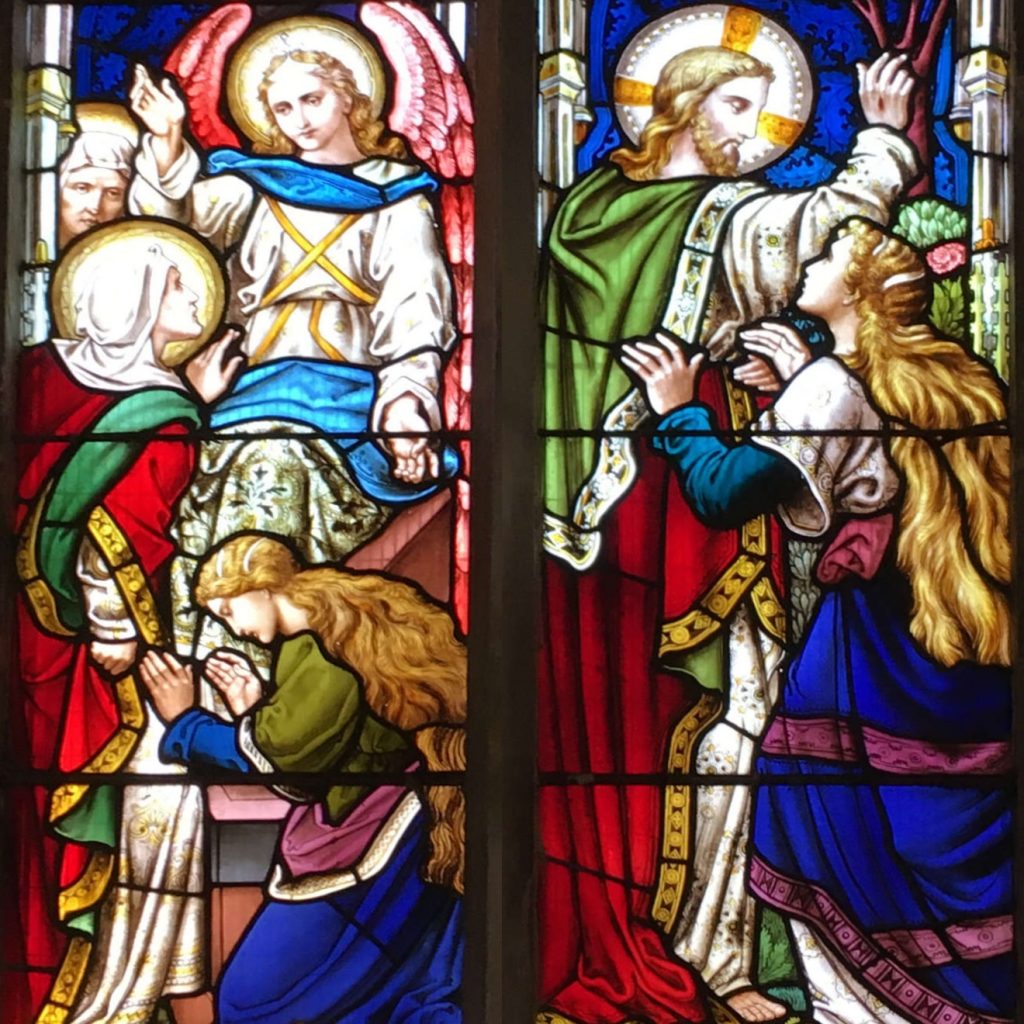
The two outer panels of the south window in the Sanctuary of Corby Glen Church depict Mary Magdalene on the first Easter day

Today, the church remembers Mary Magdalene in the gospels of Matthew, Mark and Luke. Mary Magdalene is described as one of the women from Galilee, who gave financial and domestic support to Jesus and his disciples. She is also described as having been present at Jesus’ crucifixion and burial. However, it is in John’s gospel that Mary Magdalene is given pride of place as the first witness of the resurrection and of the risen Christ himself.

Down the centuries, a considerable mythology has grown up around the persona of Mary Magdalene, much of it negative. In fact, the gospels give little evidence of her character. It is only in Luke’s gospel that we read seven demons had gone out of her, and it is generally assumed that it was Jesus who had exorcised her. This reference is followed immediately by the account of Jesus’ feet being anointed by a sinful woman at the house of Simon the Pharisee. Rightly or wrongly, it has been assumed by many, that the sinful woman was Mary Magdalene.

So why does the church remember this little-known character from the gospel narrative? The answer, I believe, lies in today’s reading.

It was Mary Magdalene, not one of the twelve, who found the empty tomb, and first encountered the risen Christ.

It was also to Mary Magdalene that something new was revealed. In the midst of the tears and the joy that must have overwhelmed Mary, Jesus gave her news of a new relationship between God himself and the whole of humanity.

Jesus said, Go to my brothers. Previously, they had been his disciples, servants, or friends.

Jesus said, I am ascending to my Father, and your Father; my God, and your God. Previously Jesus had spoken of the Father, or the Father who sent me, or my Father.

To this faithful penitent, the risen Christ revealed, in just a few words, tucked into the shadow of the most amazing moment in human history, an invitation to us all, an invitation to become his brother or sister, a child of the same heavenly Father, the Father who is also the one true God.

I hope and pray that you are rushing to accept that invitation right now.

Categories
Festival Ordinary Time

Reflection on John 20.24-29 (Thomas, 03.07.2020)

There are very few Christians who can say that they have never experienced times of doubt.  Even our Archbishop of Canterbury Justin Welby once spoke to a journalist of his own times of doubt.

In the verses immediately preceding today’s reading we hear of the other disciples rejoicing, only after Jesus had shown them his hands and his side.

We should not be surprised by Thomas’ doubt. In fact, we could view it as an example of faithful discipleship. Jesus had warned his followers to be wary of false messiahs and false prophets. Thomas was being cautious and taking care to obey his Lord and Master.

Despite these additional thoughts, we still identify Thomas as being the one who doubted.

Faith is an essential part of living as a Christian. None of us can share in the first disciples’ privileged position of actually seeing the risen Jesus, complete with the wounds of the crucifixion. We have to number ourselves with those who have not seen and yet have come to believe.

For many, belief comes before faith. These people develop a confidence in their picture of Jesus, and then comes the personal commitment to follow him in faith. For others, the process is reversed, a leap of faith is made without a foundation of any particular beliefs. Wherever we are on this spectrum, belief and faith each give rise to doubt.

For many Christians doubt occurs whenever a gap opens between our personal experience and the picture of dogma, tradition and scripture that we have chosen to live by.

It is commonly thought that strong faith never doubts. But … we need to be wary of that phrase ‘strong faith’. What it usually means is ‘faith set in concrete’: beliefs and religious practices that are never allowed to vary and develop, beliefs and religious practices that eventually stand in the way of us developing a living relationship with our Living God.

Thomas doubted. But, Thomas was ready to have it proved that he was wrong. His strong faith in Jesus still allowed his mind to open when confronted with something new, something unexpected, something that had definitely never been seen before.

Then Thomas spoke those words that should be ever on our own lips: My Lord and my God.

May those words of Thomas be ever with us as we face the challenges that cause us to share in his moments of doubt.