Categories
Ordinary Time

Reflection on Matthew 13.10-17 (Week 16 Thursday, 23.07.2020)

I have always enjoyed visiting old churches and cathedrals. I enjoy standing in the places where for centuries, faithful souls have prayed to and worshipped God. I enjoy looking at the different architectural styles that have been brought together to create one glorious whole. I like to find the evidence of how individuals down the ages have lived out their lives of faith.

One of the thoughts that goes through my mind every time I visit one of those grand old buildings is about the many, many people who have been involved in the development of those buildings. What motivated them to work on massive building projects, when two thirds of the population was being wiped out by the Black Death? What inspired them to find ingenious ways to fly in the face of political and religious pressure to change their styles of worship? What held them together when local disputes bubbled over into schism and violence?

All of these thoughts tie into our reading for today.

The Jewish people had long looked for the coming of their Messiah, the anointed one of God, who would restore their former glory and primacy in the world. They had endured many hardships through hundreds and hundreds of years, and yet they had remained faithful to the promise that the Messiah would one day come amongst them and save them. Through the passage of time many people made their small contributions to the story of his Israel, never expecting to see the true worth of what they had said or done.

As with the people of Israel, so with those faithful souls, who each made their small contribution to each Christian community that we call a parish.

Jesus understood the workings of the human mind. Jesus understood that we struggle to grasp the true picture, because it is painted on far too large a canvas for us to take it all in at once, in revealing the great truths of God.

Jesus spoke in parables, in stories that engage with our normal everyday lives, in doing so. He was not doing anything particularly new.

In today’s reading, he quotes from the prophet Isaiah, who wrote of the One who would come and teach a new lesson, which would be difficult for many to understand.

And that is where we stand in the sweep of the Christian story. We become so obsessed with our version of the Christian message that we stop listening, hearing, seeing, and understanding.

Recently, I wrote in my weekly letter to parishioners of the parable of the sower. In response to that letter, I received 11 emails, an unprecedented number, which focussed on explaining how agricultural economics works in the 21st century. Not one of those emails gave me the same explanation, and not one of them mentioned the true message of the parable.

Let us set aside our human wisdom, and let us listen, hear, see, and understand the true message of Jesus Christ, the Messiah, the anointed one of God, our Lord and our Saviour.
Categories
Festival Ordinary Time

Reflection on John 20.1-2, 11-18 (Mary Magdalene, 22.07.2020)

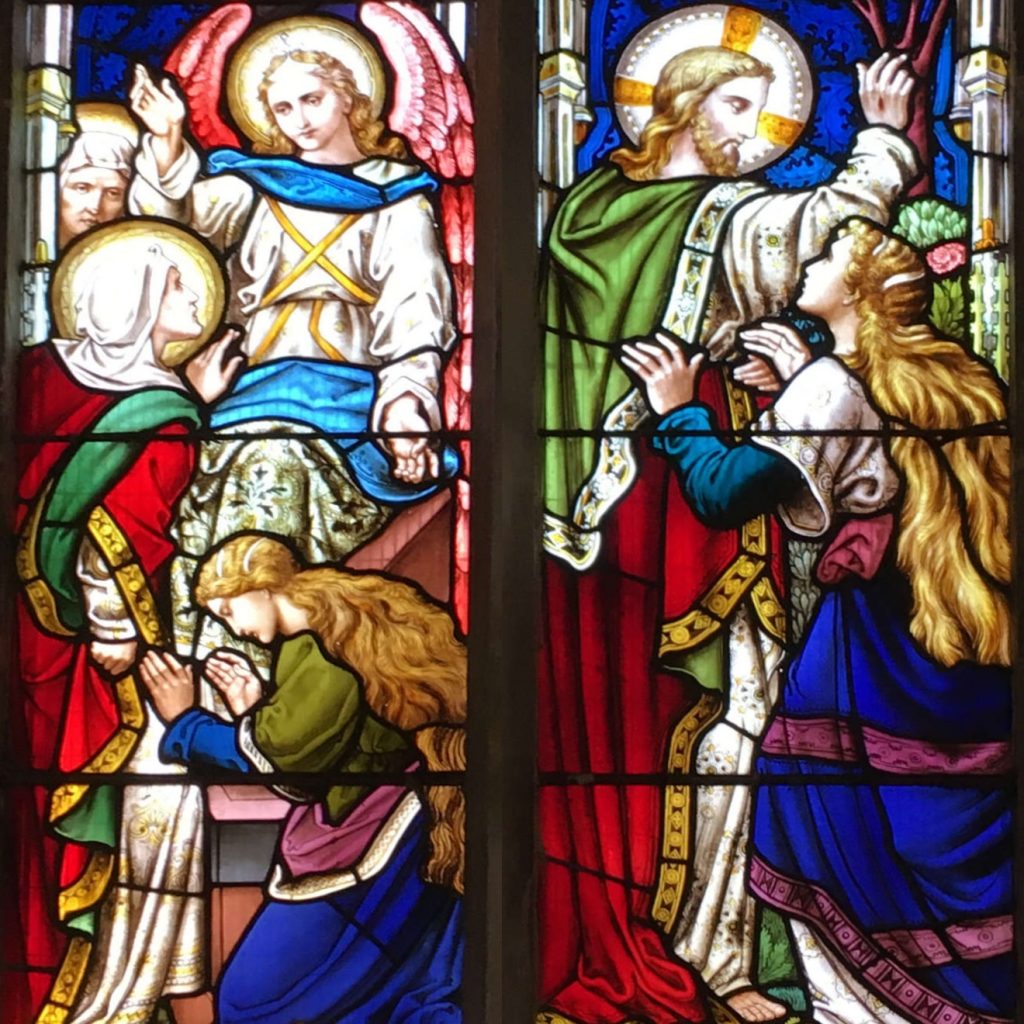
The two outer panels of the south window in the Sanctuary of Corby Glen Church depict Mary Magdalene on the first Easter day

Today, the church remembers Mary Magdalene in the gospels of Matthew, Mark and Luke. Mary Magdalene is described as one of the women from Galilee, who gave financial and domestic support to Jesus and his disciples. She is also described as having been present at Jesus’ crucifixion and burial. However, it is in John’s gospel that Mary Magdalene is given pride of place as the first witness of the resurrection and of the risen Christ himself.

Down the centuries, a considerable mythology has grown up around the persona of Mary Magdalene, much of it negative. In fact, the gospels give little evidence of her character. It is only in Luke’s gospel that we read seven demons had gone out of her, and it is generally assumed that it was Jesus who had exorcised her. This reference is followed immediately by the account of Jesus’ feet being anointed by a sinful woman at the house of Simon the Pharisee. Rightly or wrongly, it has been assumed by many, that the sinful woman was Mary Magdalene.

So why does the church remember this little-known character from the gospel narrative? The answer, I believe, lies in today’s reading.

It was Mary Magdalene, not one of the twelve, who found the empty tomb, and first encountered the risen Christ.

It was also to Mary Magdalene that something new was revealed. In the midst of the tears and the joy that must have overwhelmed Mary, Jesus gave her news of a new relationship between God himself and the whole of humanity.

Jesus said, Go to my brothers. Previously, they had been his disciples, servants, or friends.

Jesus said, I am ascending to my Father, and your Father; my God, and your God. Previously Jesus had spoken of the Father, or the Father who sent me, or my Father.

To this faithful penitent, the risen Christ revealed, in just a few words, tucked into the shadow of the most amazing moment in human history, an invitation to us all, an invitation to become his brother or sister, a child of the same heavenly Father, the Father who is also the one true God.

I hope and pray that you are rushing to accept that invitation right now.

Categories
Ordinary Time

Reflection on Matthew 12.46-50 (Week 16 Tuesday, 21.07.2020)

I am sure that we have all heard the proverb The road to hell is paved with good intentions.

Perhaps fewer of us have come across its alternative form: Hell is full of good meanings, but heaven is full of good works.

It is so easy for all of us to intend to do good. But so often those intentions slip further and further down our to-do lists. We become distracted and diverted, and we quickly forget all that good we intended to do.

Very often the distractions and diversions that get in the way of our Christian discipleship are rooted in family and friends. Some sort of personal crisis, whether real or perceived, arises, and every good work we intended to do is swept aside.

It is in exactly these sort of circumstances that the terrible phrase charity begins at home is used. We forget Christ’s teaching on love and service. We cast aside the challenge to love our neighbour as ourselves. We do not give a second thought to Jesus’ teaching that every time we care for a stranger, we are caring for him.

And to make the situation worse, our families and friends often demand that they be given priority over everything else, no matter how trivial their need, simply because they are family and friends.

In today’s reading, Jesus seems to have very harsh words to say about his family. But does he really?

Jesus is addressing the crowds. He is teaching those who have come to hear the good news. Unexpectedly, his family show up, and we are told they want to speak to him.

Now read the text carefully.
Jesus does not dismiss them or reject them.
Nowhere does it say that he does not go out and speak with them.
Instead, the text says that he uses their presence as an illustration.

Jesus says to his disciples, as he says to us, You too can be part of my family if only you will set aside the transient good intentions, and live the life of faithful discipleship.

So, how are our to do lists looking? Are Christian love and service at the top of the list? Are we strong enough to keep Christian love and service as our number-one priority?

Categories
Ordinary Time

Reflection on Matthew 12.38-42 (Week 16 Monday, 20.07.2020)

I really enjoy doing crosswords when I pick up a newspaper. I always take a quick look at the crossword first – I like to see what sort of intellectual challenge lies ahead of me. Has this one been set by someone who thinks like me, or is it going to be a linguistic fight to the death? Am I going to know the satisfaction of completing the grid, or am I going to be wishing I could ask the setter for a different more accessible clue?

In today’s reading, we encounter the scribes and the Pharisees asking Jesus for a more accessible and comprehensible clue.

We also encounter Jesus saying, in effect, ‘No, work it out for yourselves.’

Of course, those scribes and Pharisees are surrounded by clues. They really do not need any more. The Hebrew scriptures, which we know as the Old Testament, is overflowing with relevant prophecies.

Jesus himself is present with them. Through his teaching and signs of power, he is bringing the Old Testament prophecies to life.

But, despite all of those clues, the scribes and the Pharisees just cannot see the answer they are looking for. The day is coming when it will be impossible to miss the answer. When Jesus has died and then risen from the grave, everyone will know the truth. But until then, human doubt, uncertainty, and scepticism keeps the scribes and the Pharisees from completing the puzzle.

Jesus does try to help them. He points them towards two easily understood stories from their own scriptures, but still the connections are not made.

So how are we doing with the puzzle? Are we so caught up in following our own agenda that we are missing the blindingly obvious? Or, can we at last see who Jesus is, and what he came to earth to do?

And if we are able to complete the puzzle, have we also found the strength and the determination to live the life of love and service that was modelled by Jesus himself?

Categories
Ordinary Time

Reflection on Matthew 12.14-21 (Week 15 Saturday, 18.07.2020)

In the two weeks since my final session of chemotherapy, the whole tone of my email inbox has changed. It would appear that some people feel that I am now ready to be criticised and nagged about a whole host of trivial matters. The ultimate example of this was demonstrated by the email that began ‘I know that you are supposed to be unwell…’

As I have begun to field these emails, I have often thought of today’s reading. To date, as far as I am aware, no one has conspired to destroy me, but I suppose you never know.

I open today’s reflection in this personal way because so many of us encounter such mundane pressures at moments when we are already feeling weak and vulnerable.

That is certainly where we meet Jesus today. He felt so threatened and vulnerable that he departed.

But the need for him did not go away, and he continued in his ministry, faithfully and lovingly he carried on healing those who were unwell and possessed.

It is at this point in Matthew’s gospel that we are given words from the prophet Isaiah. These words are well known, and they remind us of Jesus’, and by extension, our call to serve.

Jesus was beset with so many complaints and anxieties and threats, but he remained focussed.

In recent months, the nature and the intensity of the complaints, anxieties, and threats that we have had to deal with have changed.

But we are still called to carry on loving and serving in the name of Christ.

The question at the end of this week is still: How do we love and serve in the name of the One who gave everything for us?

Or are we so wedded to our need to be in control of everything and everyone around us, that we continue to miss the point of Jesus’ call in our lives?

Are we still so anxious and overburdened, physically and mentally, that we forget that Jesus can take care of all of that for us?

Are we ready to open our hearts and minds, and let Jesus direct us along the path that leads to true life in him?

Categories
Ordinary Time

Reflection on Matthew 12.1-8 (Week 15 Friday, 17.07.2020)

Human beings love rules and regulations.

Well, when I say they love rules and regulations, I really mean that they love the ones that they find convenient. People really love to use rules and regulations to control others, to create the sort of order that they want in their own lives.

In today’s reading, we encounter just such a use of the Jewish law. The Pharisees, the experts in Jewish law, took the opportunity to criticise the disciples for picking some heads of grain and then eating them.

Of course, technically, the Pharisees were right, but what about the needs of those men? Should the rules and regulations be so intransigent that the need of the individual is considered irrelevant?

Jesus reminds the Pharisees of their own history. He recalls the Old Testament account of David and his companions, eating the most holy bread in the temple, just because they were hungry. Then he reminds them that the temple priests are seen as having some sort of dispensation, so that they can work in the temple on the sabbath.

Jesus is, in effect, saying, what’s the difference?

Of course, there is a difference.

Jesus is present with his disciples, and he is saying that there are more important things to worry about than picking and eating a few heads of grain.

And Jesus is saying that he can make that decision because of who he is.

So, how often have you ranted and railed against the breaking of petty rules and regulations?

And when you have found yourself in that place, how often have you paused to think about the real needs of those who have offended your sense of order?

This is not an easy challenge for us to have to face up to, but, if we wish to be true disciples of Christ, we have to let go of our need to be the ones in control. We have to learn to trust Jesus.

Because he never gets it wrong.

He really is the Lord of the Sabbath. 

Categories
Ordinary Time

Reflection on Matthew 11.28-30 (Week 15 Thursday, 16.07.2020)

To feel that you have a real relationship with Jesus Christ should be both warming and really, really scary.

Yesterday we read of Jesus as being the one whose intimate acquaintance with God is so complete that by getting to know Jesus, we get to know God. Just think about that for a moment.

In my life, I have met so many people who have been overwhelmed by the possibility of a passing encounter with a famous person. A close relationship with Jesus is on a totally different scale, because Jesus and God are one.

To get to know Jesus is to lay ourselves open in a way that strips away all our human pride, intransigence, greed, anger, and so on.

Getting to know Jesus is really scary, because our façade is stripped from us, and we stand before him in the harsh reality of who we really are.

And, when our façades are so effectively stripped from us, we come to realise that keeping up the pretence is exhausting.

We realise that we are weary, and weighed down with guilt and dishonesty, and with all that other negative stuff.

When we see ourselves in this light, when we finally let go and trust in the friendship of Jesus Christ, then the famous words in today’s reading make perfect sense.

Then we will find ourselves ready to let Jesus bathe our wounds. He will clothe us in all Christian virtues, and bring us into the perfect rest that only he can offer.

So often this text is misused as some sort of spiritual comfort blanket, for those who are facing a tricky day or two.

Let us not fall into that trap.

Rather let us take that step into the unknown, and revel in God’s healing and comforting love, in order that we might be better disciples, in the challenging world in which we live out our daily lives. 

Categories
Ordinary Time

Reflection on Matthew 11.25-27 (Week 15 Wednesday, 15.07.2020)

There are many moments in the life of a priest when you have to pinch yourself and ask God why you have been chosen out of so many who would have been so much better than you. One of those moments that recurs time and time again is when you are travelling with a family that is both mourning the loss of a loved one and preparing a suitable celebration of that dear and precious life.

During that journey you find yourself sharing in moments of profound intimacy. People speak with a knowledge and authority that no one else could possibly possess. A surviving spouse, children, siblings, close friends, sometimes parents – each bring their own pieces, to construct an elaborate and detailed jigsaw that is absolutely unique. To be a part of the team that constructs such a jigsaw is an incredible and humbling privilege.

In today’s reading, we encounter Jesus, issuing an invitation that should make our spines tingle.

As the human Jesus has grown into the man we know from the gospel narrative, so has developed and matured Jesus’ own certainty of his unique knowledge of and relationship with God.

And Jesus invites us to share in the intimacy of the relationship he has with his heavenly Father, simply by drawing closer to him.

If we become a friend, follower and disciple of Jesus Christ, then we will also become one of those who can truly call God, Abba, Daddy.

The good thing is that we do not have to watch for the post for a special envelope to arrive. Jesus issued his invitation 2000 years ago. We just have to RSVP.

Listen to his words.

And live the life he has given us to enjoy and to use in his name.

I wonder who we will see at the party. 

Categories
Ordinary Time

Reflection on Matthew 11.20-24 (Week 15 Tuesday, 14.07.2020)

At some point in all of our lives, we have been guilty of knowing the right thing to do, of recognising the right path to take, but going our own way, regardless of that knowledge. Often we dress up our wilful stubbornness in clothes of self-justification, self-assurance, and principle. But if we can find the humility to step outside our pride, we know deep inside that we are not being faithful to God.

Today’s reading begins with Jesus condemning towns that he had witnessed following the path of self-condemnation and self-destruction.

Jesus had lived, taught, and worked his deeds of power in Capernaum. The towns of Corrizon and Bethsaida were just a short journey from Capernaum.

All the people Jesus condemns had actually seen Jesus, they had actually heard Jesus, they had witnessed at first hand his divine power at work, but what difference had it made?

None at all, as far as Jesus could see. Like many of us, they just carried on in their proud, greedy, and condemnatory ways.

Can we not feel Jesus’ despair?
Or are we content that we know better?
Or are we feeling sympathetic towards the towns condemned by Jesus?

Jesus’ words to the towns where he had walked, taught and healed should be seen as a sharp wake-up call to each of us.

Throughout Scripture, we are told that the day will come when we will be judged for the way we have lived, and the way we have used our God-given time, talents, and treasure.

Today Jesus is hammering that message home.

It is never too late to repent, and follow the path God has prepared for us.

But are we ready to face that challenge? 

Categories
Ordinary Time

Reflection on Matthew 10.34 – 11.1 (Week 15 Monday, 13.07.2020)

As we have been journeying through Matthew’s gospel in our daily readings, we have come to see Jesus in a context that makes many feel uncomfortable. We have been brought face to face with Jesus the innovator, Jesus the bringer of the new – and the different Jesus has taught us to seek a new and more intimate relationship with his and our Father in heaven. And he has taught us to pray in a different way, and of course, he has stretched out the hand of healing love to the untouchables of society.

Today, Jesus reveals himself as the great innovator yet again.

The words that Jesus speaks about division and conflict would not have been new to his Jewish audience. They come from the writings of the Old Testament prophet Micah. By quoting these words, Jesus is reminding us that it has always been known that true love of God might well separate us from even those most near and dear to us in this world.

But, having delivered these words of dire warning, Jesus also reminds us that those who live the life of true discipleship will come to know the joy of eternal life in the nearer presence of God in heaven.

Jesus also reminds us that devoting ourselves to following him, above all earthly demands, is not a mere intellectual exercise.

Jesus tells us that the simplest acts of Christian love, even the quenching of the thirst of the most challenging social outcast, is an act of love to our Lord himself.

Such acts of love may have been difficult during our days of lockdown, isolation and chilling, but they were not impossible.

Have you demonstrated your devotion to Jesus?

And how will you show that devotion even more as the lockdown eases?